
Home Environment Adaptations
It is a known fact that features within a home or a person’s local environment can positively or negatively affect their ability to move safely and independently. Handrails, modified steps and adapted furniture are commonplace in the homes of people that have a physical disability. They are logical additions to minimise trips, stumbles and falls all of which can aggravate and progress arthritis and other musculoskeletal diseases.
Occupational Therapy is a distinct discipline within the field of human medicine dedicated to assessing an individual with their own unique challenges, in the context of their own home, and then finding solutions by either modifying the environment or the task to ensure they are protected from accidental harm.
The importance of creating accessible and safe environments cannot be overstated, especially for individuals with physical disabilities or those managing chronic conditions like arthritis. When considering a property, it is essential to look beyond aesthetics and focus on the practical features that can enhance the quality of life for its occupants. For example, homes with wide doorways, step-free entrances, and accessible bathrooms can significantly reduce the risk of accidents and promote independence. These modifications are not just beneficial for the elderly or disabled but can also be a valuable selling point, appealing to a broader range of buyers who prioritize safety and accessibility.
Our pets are also vulnerable to harm from obstacles of daily living that were once easy to navigate, but with a physical impairment become a risky challenge. Simple inexpensive modifications are hugely beneficial to assist our companions achieving a comfortable life well into old age.
These interventions are often overlooked as there is a belief that a dog is more agile and stable than a human because they have four legs. Unfortunately this is not true. With diseases like arthritis, that cause pain and reduced function, the dog will offload that limb and use it less. Muscle mass and function reduces, as if you don’t use it, you will lose it. This functional loss also includes strength, balance, reaction times and agility. They lose their physical coping mechanisms, and what was once easy becomes hard. A few steps from the living room to the kitchen become a balance challenge. The stairs to the bedroom become hard work for weak wobbly limbs leaving them liable to falling.
Through adapting your dog’s environment you will not only improve their physical comfort levels and reduce the risk of injury, you will likely slow the progression of the disease, and positively influence their emotional state through reducing stress and anxiety.
Owners must remember dogs are incredible at coping with the world that we surround them in. They will continue as best they can no matter the circumstance. A dog with painful, weak limbs will continue to cross a slippery floor to reach the resources that are important to them such as their food and water, or their exit point to the garden, or to simply be with their owner/friend. This does not mean that that activity is not painful or dangerous to them. Comprehending their capability, being aware of the risks and adjusting to improve safety and comfort is an essential part of a chronic pain management plan.
OBSTACLES AND ADAPTATIONS
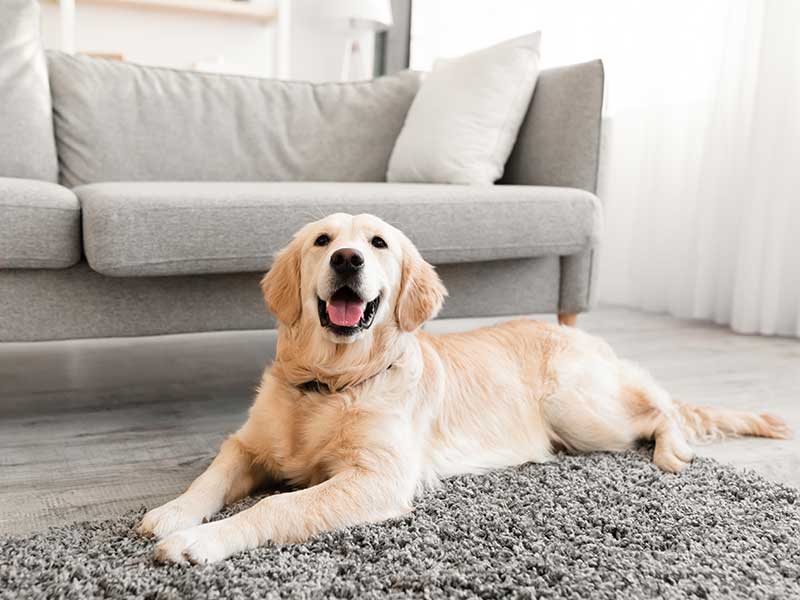
COVER SLIPPERY FLOORS
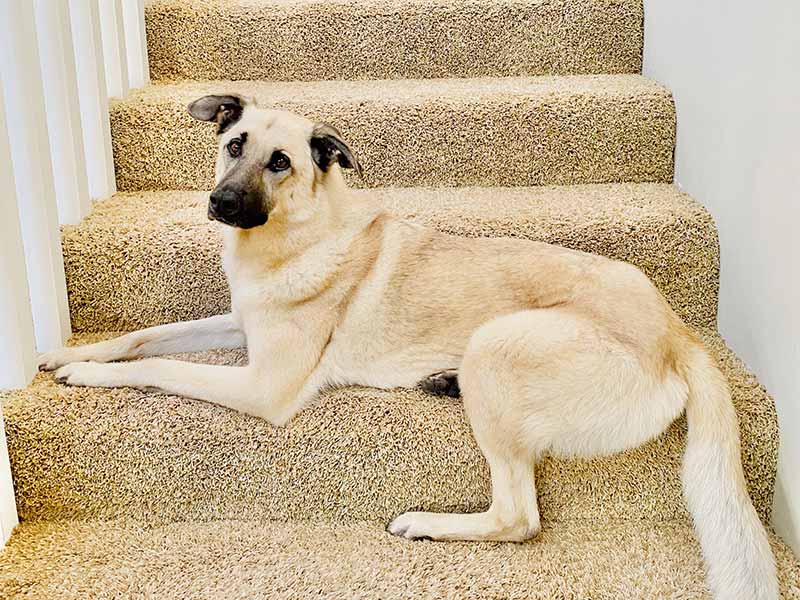
ADAPT YOUR STAIRS

Find a suitable bed
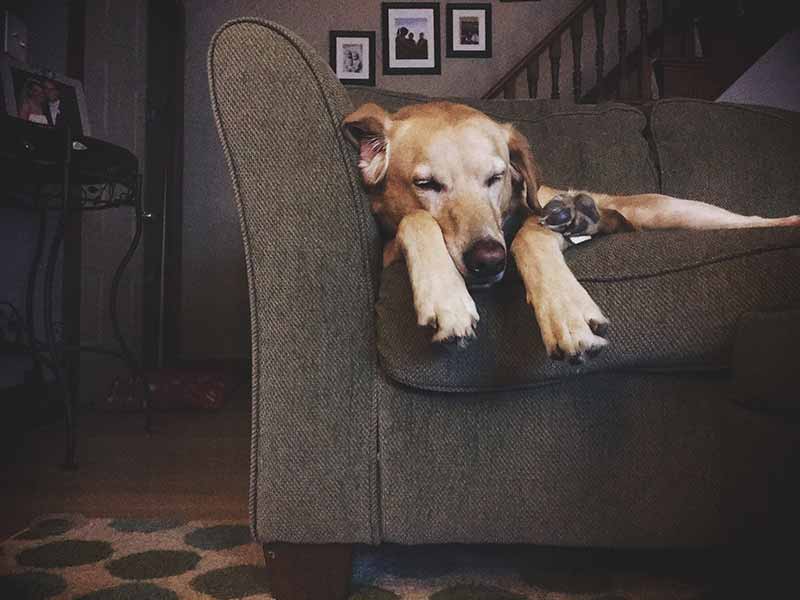
Consider Furniture access
Here is a non-exhaustive list of common potentially harmful obstacles dogs face in homes around the world and how they can be adapted.
Many homes now have wood, laminate or tile flooring, particularly in areas such as kitchens, where dogs spend much of their time. Dogs have to work hard to prevent themselves from slipping on these surfaces. Their pads are designed to withstand rugged terrains, thus are hard and tough, not grippy. Add some overlying fur and they become like slippery socks.
Preventing their limbs slipping away from them whilst walking on slippery floors becomes more difficult as their muscles weaken with age and reduced use, and their joints become painful and stiff with arthritis.
Slips sound innocent and inconsequential, however, especially if repetitive, they will traumatise less flexible inflamed joints and pull compromised muscles, ligaments and tendons out of their normal range. A slip can cause significant damage as a stand alone or event. Or they can build over time continuously traumatising tissue that is trying to heal. Preventing this repetitive trauma and pain using simple measures is likely to make life easier both in the short and long term for the arthritic dog.
Are you thinking my dog has never complained? You have never heard them whimper, yelp or limp after a stumble, slip or fall? You likely won’t. Dogs cope and often give off very few overt signs suggesting difficulty or discomfort. Instead you may witness subtle behavioural changes, or hesitation and avoidance. Put it like this, when my lovely old girl was 14 years old and suffering from multiple sources of arthritic and nerve related pain, I only heard her yelp once, when she touched an electric fence with her nose!
Dogs cope, but they don’t need to! As their advocate you can preempt their challenges and minimise them.

Check out our sponsors Floors For Paws and their anti-slip dog-friendly floors if you are thinking about fitting new flooring.
Stairs are one of the most challenging areas for the arthritic dog. Climbing or descending the stairs in a controlled safe fashion requires strength, coordination and balance. A common adaptation that less able dog’s employ is to do obstacles at speed, as they have more momentum to complete the physical challenge. Coming down stairs fast does not mean that they find them easy. It likely means they are out of control.
In progressed cases of arthritis, where the dog struggles with coordination and strength, the best solution is to avoid them if at all possible. Restricted access can be maintained with a stair gate. However, in many cases this is not possible. Getting around the house requires negotiating some stairs. Or the owner-dog relationship has always featured sharing the same sleeping space, so removing that would lead to anxiety and frustration.
In these situations, the owner may be able to carry the dog if small. The owner must not risk their own safety carrying their dog up and down stairs. Where carrying is not possible, there are some adaptations that may help including the use of a ramp for steps, or fitting your dog with a harness such as the “help em up harness” to give them support.
Door thresholds look innocuous but can be tricky for dogs to negotiate and are a common cause of trips and falls. They often require the dog to clear a significant height and breadth with all four limbs multiple times per day.
These obstacles are often unavoidable, if the only access point to the house, but can be adjusted with half height steps, non-slip mats and anti-slip tape along any slippery surfaces that they may perch a foot on.
Humans are significantly taller than dogs and have larger strides so can clear many obstacles with ease. Less able dogs may get caught out by often simple objects such as shoes, toys, wires or even loose and curled up rug edges. Be conscious of the small challenges they face on their routine pathways and try to minimise them.
The ability to rest comfortably is a basic requirement for all of us and is particularly important for a dog with arthritis. Decreased quality sleep is noted with chronic pain conditions like arthritis. Failing to settle can be an indicator of uncontrolled pain as well as a target to improve a dog’s ability to cope with their condition. Inadequate amounts of deep sleep is known to negatively influence humans managing chronic pain conditions, it is a logical translation the same will apply to dogs.
Bedding type, depth, size, access and location preferences are individual, and an owner should observe their dog’s responses to adjustments and tailor to suit. Some dogs prefer to curl up in a padded, easy access basket in the hustle and bustle of the home, while others want to stretch out on firm shallow cool bedding in privacy.
Owners should consider adjustments such as locating in a warm draft free position, providing a mattress that is both supportive and conforming, ensuring the bed has trip-free access and that their dog can change their position without difficulty.

Check out our sponsors Big Barker whose beds for large dogs help create comfort and support for the bigger dog!
Many dogs share sofas and armchairs with their owners. Some may also sleep in bed with their owner. Getting on and off these can be a challenge and a massive risk for a dog with arthritis. Remember, arthritic joints do not like impact forces, so to avoid them consider encouraging your dog to sleep on an alternative suitable bed on the floor. If that is not an option and sharing the sofa or the bed represents an important interaction with their owner, then access must be made safer by the use of a ramp or small steps or by training your dog to accept being lifted onto the furniture.
As previously mentioned, arthritis will inevitably affect other parts of your dog’s body due to weight shifting away from the pain of joint use. Other regions have to compensate and work harder, eventually succumbing to overuse injuries. A dog with hip arthritis may become very stiff and uncomfortable through their neck and shoulders. With this in mind, adapting a dog’s access to food and water through raising their bowls to roughly elbow height, so that they do not have to lean heavily forward can reduce the difficulty of these activities of daily life. Feeling stable and comfortable whilst eating will ensure that the dog enjoys their meal time.
Please note there is an association between large and giant breed dogs with raised feeding stations being more likely to suffer from gastric dilation volvulus. In these situations raising the water bowls and using slow feeders for their food may be an appropriate compromise.
These are a common addition to homes particularly when owners work during the day and have to leave their dog at home. They are often fitted when the dog is young and can be used with ease. However, with reduced strength, coordination and balance, dog flaps can be particularly difficult for an arthritic dog to negotiate. They may bump painful joints and tissue as they are no longer as flexible.
Observing your dog moving slowly through the dog flap and adjusting as required is advised. Alternative arrangements may need to be made.
Just as indoor passageways need to be clear of hazards and have a non-slip surface, the same applies to outside surfaces. Dogs are creatures of habit and tend to use the same routes to get to toileting and recreational areas. Hazards include loose paving stones, wet or muddy paths, slippery wooden decking, steep slopes and poorly lit areas.
Apply the same logic that was used to make the inside of a home safe. Steps may need to be blocked off and replaced with ramps.
Dogs are creatures of habit and tend to use the same areas for toileting. Most dogs will become distressed if they are not able to get outside quickly enough to toilet. Owners may notice that their dog changes their posture for toileting, or may start to walk as they try to pass a stool. They may even have ‘accidents ‘ in the house.
Ensuring a less able dog has easy access to a toileting area, which is free from hazards and has a non-slip surface so that they feel stable while posturing to urinate or defecate is essential.
Socialising with other dogs in the same household, or when ‘out and about’, will be more concerning for the dog in pain and weak on their limbs. The rapid movements of gentle play may be too much for dogs with advanced arthritis.
The hustle and bustle of feeding time can leave them vulnerable to slips, falls and further injuries. Associating the discomfort that comes with these activities with the other dog is common and can lead to challenging behavioural changes.
Feeding separately, prioritising their safe movement inside and outside the home, and closely monitoring play to ensure it remains gentle and within the ‘comfort zone’ of the affected dog is wise.
Travelling in a car is often unavoidable and provides a few significant challenges for a dog with arthritis. Getting in and out of the car, as well as travelling comfortably may require some adaptations. This may mean lifting in and out, or using ramps or steps. As well as ensuring there is comfortable supporting bedding for them to lay and lean on. We don't notice the unexpected forces placed on our bodies when driving because we are belted into contoured seats. The irregular, consistent and uncontrolled movements in the rear of a car can be very hard work for an arthritis dog to manage.
